

The Jahangir graph  is a kind of generalized wheel graph consisting of
 circular vertices
and a central vertex connected to every
 th vertex around the circle.
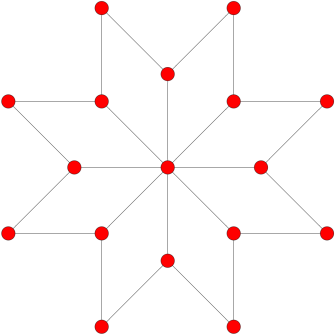
This class of graphs is named after the figure illustrated above corresponding to  which appears on the tomb of Nur-ud-din Muhammad Salim, known by his imperial name,
Jahangir. Jahangir was the fourth Mughal Emperor who ruled from 1605-1627. His tomb
is located 5 kilometer northwest of Lahore, Pakistan along the banks of the River
Ravi (Mojdeh and Ghameshlou 2007).
Jahangir graphs  are unit-distance and matchstick
graphs for
 (the wheel graph
 ) and all
 .
Special cases are summarized in the following table.


 -

 -
Jahangir graphs are implemented in the Wolfram Language as GraphData[{"Jahangir", {n, m}}].
For  and
 , Imbesi and Pedalà (2026) give an explicit
graceful labeling with an additional monotonicity
property. After a specified closing edge is removed
from the outer cycle graph, the successive absolute
differences of the endpoint labels along the resulting path
are strictly increasing for even
 and strictly decreasing for odd
 , with the traversal chosen in their construction. The
result supplies a particular family of labelings, rather than asserting that every
graceful labeling has this property.

 ." Bull. Math. Soc. Sci. Math. Roumanie 51,
177-182, 2008.House of Graphs. Jahangir Graphs.
 -Colouring
of Jahangir Graphs." 28 Jun 2018.
 ." Int. J. Contemp. Math. Sci. 2,
1193-1199, 2007.Munir, M.; Nazeer, W.; Kang, S. M.; Qureshi, M. I.;
Nizami, A. R.; Kwun, Y. C. "Some Invariants of Jahangir Graphs."
Symmetry 9, No. 17, 15 pp., 2017.Tomescu, I. and
Javid, I. "On the Metrix Dimension of the Jahangir Graph." Bull. Math.
Soc. Sci. Math. Roumainie 50, 371-376, 2007.