


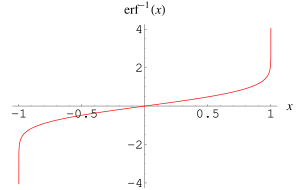
The inverse erf function is the inverse function  of the erf
function
 such that
 |  |  |
(1)
|
 |  |  |
(2)
|
with the first identity holding for  and the second for
 . It is implemented in the Wolfram
Language as InverseErf[x].
It is an odd function since
 |
(3)
|
It has the special values
 |  |  |
(4)
|
 |  |  |
(5)
|
 |  |  |
(6)
|
It is apparently not known if
 |
(7)
|
(OEIS A069286) can be written in closed form.
It satisfies the equation
 |
(8)
|
where  is the inverse erfc function.
It has the derivative
 |
(9)
|
and its integral is
 |
(10)
|
(which follows from the method of Parker 1955).
Definite integrals are given by
 |  |  |
(11)
|
 |  |  |
(12)
|
 |  |  |
(13)
|
 |  |  |
(14)
|
(OEIS A087197 and A114864), where  is the Euler-Mascheroni constant and
 is the natural
logarithm of 2.
The Maclaurin series of  is given by
 |
(15)
|
(OEIS A002067 and A007019). Written in simplified form so that the coefficient
of  is 1,
 |
(16)
|
(OEIS A092676 and A092677). The  th coefficient
of this series can be computed as
 |
(17)
|
where  is given by the recurrence equation
 |
(18)
|
with initial condition  .
Taking the natural logarithm of the normalized quotient gives the Maclaurin series
 |
(19)
|
After factoring  from the coefficient of
 , the numerators are 1,
1, 193, 143, 27319, ... (OEIS A114859) and
the denominators are 12, 90, 90720, 302400, 239500800,
... (OEIS A114860).
