TOPICS
Search

Hyperharmonic Number


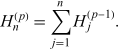
The hyperharmonic number H_n^((p)) is obtained by repeated partial sums of the reciprocals of the positive integers. Set H_n^((0))=1/n for n>=1 and H_0^((p))=0. For positive integer order p and n>=1,

 H_n^((p))=sum_(j=1)^nH_j^((p-1)).
(1)

Thus H_n^((1)) is the ordinary harmonic number H_n. For p>=1, the closed form is

 H_n^((p))=(n+p-1; p-1)(H_(n+p-1)-H_(p-1)),
(2)

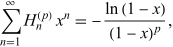
where the prefactor is a binomial coefficient (Benjamin et al. 2003). Repeated partial sums multiply the ordinary generating function by (1-x)^(-1) at each step, giving

 sum_(n=1)^inftyH_n^((p))x^n=-(ln(1-x))/((1-x)^p),
(3)

for |x|<1 and p>=0.

The hyperharmonic number is implemented in the Wolfram Language as HyperHarmonicNumber[p, n].


See also

Harmonic Number

Explore with Wolfram|Alpha

References

Benjamin, A. T.; Gaebler, D.; and Gaebler, R. "A Combinatorial Approach to Hyperharmonic Numbers." Integers 3, #A15, 2003. https://math.hmc.edu/benjamin/wp-content/uploads/sites/5/2019/06/A-Combinatorial-Approach-to-Hyperharmonic-Numbers.pdf.

Cite this as:

Weisstein, Eric W. "Hyperharmonic Number." From MathWorld--A Wolfram Resource. https://mathworld.wolfram.com/HyperharmonicNumber.html

Subject classifications