

Heun's method, also called the explicit trapezoidal method or improved Euler method, is a two-stage second-order explicit Runge-Kutta method. For the initial value problem
 |
(1)
|
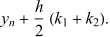
it advances an approximation by
 |  |  |
(2)
|
 |  |  |
(3)
|
 |  |  |
(4)
|
The first stage is an Euler forward method predictor, while the update averages the slopes at the beginning of the step and
at the predicted endpoint. This slope average mirrors the trapezoidal
rule, while the predictor keeps Heun's method explicit. For sufficiently smooth
 , its local truncation error is
  and its global error is
  , where
  is a Landau symbol.
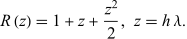
For the test equation  ,
the stability function is
,
the stability function is
 |
(5)
|
The name "Heun's method" is also used for other Runge-Kutta methods introduced by Heun, including a three-stage third-order formula (Butcher 2016).
