

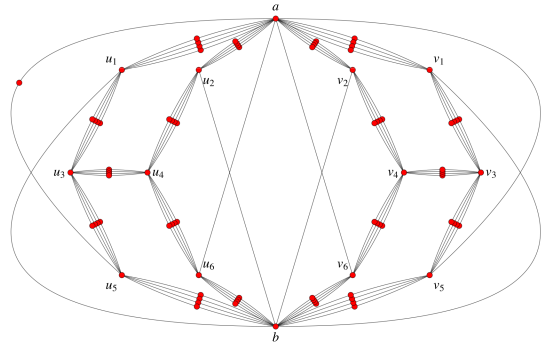
In the terminology adopted in this work, a Hernández-Vélez-Leaños-Salazar graph is a member of the two-parameter family of simple
graphs constructed by Hernández-Vélez et al. (2017, Theorem
2) for integers  . The family gives graphs
with a fixed graph crossing number and arbitrarily
large pseudolinear crossing number
and rectilinear crossing number.
. The family gives graphs
with a fixed graph crossing number and arbitrarily
large pseudolinear crossing number
and rectilinear crossing number.
A drawing of a graph is pseudolinear if its edges can be extended to a pseudoline arrangement in which
each pseudoline contains exactly one graph
edge of the drawing. The pseudolinear
crossing number  is the minimum number of pairwise crossings
in such a drawing. Every rectilinear drawing
is pseudolinear, so
is the minimum number of pairwise crossings
in such a drawing. Every rectilinear drawing
is pseudolinear, so  .
.
Start with a graph on 14 vertices, labeled  ,
,  ,
,  , ...,
  ,
,  , ...,
  . Designate as heavy the 18 edges
in the two cycles with cyclic vertex
orders
. Designate as heavy the 18 edges
in the two cycles with cyclic vertex
orders  and
and  , together with the edges
  and
and  . Here
  denotes the undirected edge
joining vertices
denotes the undirected edge
joining vertices  and
and  . Add eight light edges, namely
 ,
,
 ,
,
 ,
,
 ,
,
 ,
,
 ,
,
 ,
and
,
and  .
.
Replace each heavy graph edge by  paths of two edges
joining its endpoints, and replace
paths of two edges
joining its endpoints, and replace  by
by  such paths. All internal vertices of these replacement paths
are new and distinct. Leave the other seven light edges
unchanged. The resulting simple graph
such paths. All internal vertices of these replacement paths
are new and distinct. Leave the other seven light edges
unchanged. The resulting simple graph  has graph order
  , edge count
  , graph crossing number,
and rectilinear crossing number satisfying
, graph crossing number,
and rectilinear crossing number satisfying
 |  |  |
(1)
|
 |  |  |
(2)
|
 |  |  |
(3)
|
 |  |  |
(4)
|
 |  |  |
(5)
|
To convert the weighted graph construction to a simple graph, each weighted graph
edge is replaced by internally disjoint two-edge paths. Their internal vertices
prevent the creation of multiple edges. The  paths replacing
  are needed only when
  because
  crosses one graph edge of
each
crosses one graph edge of
each  in the proof, contributing
  of the
  crossings; the pairs
  ,
,
 ,
and
,
and  contribute the other three. When
  , however,
  is replaced by only one two-edge graph path, so the lone vertex
of vertex degree 2 on that graph
path is an artifact of applying the conversion uniformly. This vertex
is absent from Figure 2 because that figure shows the base graph
is replaced by only one two-edge graph path, so the lone vertex
of vertex degree 2 on that graph
path is an artifact of applying the conversion uniformly. This vertex
is absent from Figure 2 because that figure shows the base graph  before the replacements. It can be removed by graph
smoothing, restoring the graph edge
before the replacements. It can be removed by graph
smoothing, restoring the graph edge  . More generally, smoothing
the internal vertex of any one of the
. More generally, smoothing
the internal vertex of any one of the  replacement paths for
  gives a homeomorphic graph
  with
with  vertices and
  edges, while
  . Although the rectilinear
crossing number is not invariant under graph smoothing
in general, this graph still satisfies
. Although the rectilinear
crossing number is not invariant under graph smoothing
in general, this graph still satisfies  : subdividing
the restored graph edge in any rectilinear
drawing of
: subdividing
the restored graph edge in any rectilinear
drawing of  reconstructs
  without adding a graph crossing.
The analogous statement for the pseudolinear
crossing number follows from the local edge-replacement
construction of Hernández-Vélez et al. (2017, Proposition 8(b)).
without adding a graph crossing.
The analogous statement for the pseudolinear
crossing number follows from the local edge-replacement
construction of Hernández-Vélez et al. (2017, Proposition 8(b)).
Thus  guarantees a curvy graph.
For example,
guarantees a curvy graph.
For example,  and
and  give a curvy graph of graph order 105 with 189 edges
and crossing number 4. The construction does
not assert that
give a curvy graph of graph order 105 with 189 edges
and crossing number 4. The construction does
not assert that  is a minimally curvy
graph. However, when
is a minimally curvy
graph. However, when  and
and  ,
,  has a minimally curvy
graph
has a minimally curvy
graph  as a topological minor.
Indeed, repeatedly passing to a proper topological
minor that is still a curvy graph must terminate,
since each step reduces the graph order or edge
count. The resulting minimally curvy graph
as a topological minor.
Indeed, repeatedly passing to a proper topological
minor that is still a curvy graph must terminate,
since each step reduces the graph order or edge
count. The resulting minimally curvy graph  has crossing number at most 4, since graph
crossing number does not increase when taking a topological
minor. It cannot have crossing number
at most 3, since then its rectilinear crossing
number would equal its graph crossing number
(Bienstock and Dean 1993), contradicting that it is a curvy
graph. Thus
has crossing number at most 4, since graph
crossing number does not increase when taking a topological
minor. It cannot have crossing number
at most 3, since then its rectilinear crossing
number would equal its graph crossing number
(Bienstock and Dean 1993), contradicting that it is a curvy
graph. Thus  has crossing number
exactly 4.
has crossing number
exactly 4.
