

The Hamming scheme  ,
where
,
where  and
and  ,
is the association scheme on
,
is the association scheme on  for an alphabet
  of
of  symbols. For
  , 1, ...,
  , its relations are
 |
where  is the Hamming distance.
The relation  is the adjacency relation
of the Hamming graph
is the adjacency relation
of the Hamming graph  , and
, and  consists of the pairs at graph
distance
consists of the pairs at graph
distance  .
Each relation
.
Each relation  has valency
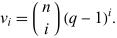 |
The adjacency matrices of its relations belong to its Bose-Mesner algebra and have
eigenvalues given by values of  -ary Krawtchouk polynomials
(Bannai and Ito 1984, Brouwer et al. 1989).
-ary Krawtchouk polynomials
(Bannai and Ito 1984, Brouwer et al. 1989).
The binary Hamming scheme  is the ambient association
scheme for binary codes of length
is the ambient association
scheme for binary codes of length  (Schrijver 1979). At a base point, its Terwilliger
algebra can be block diagonalized to obtain semidefinite
programming upper bounds for binary
codes and constant-weight codes (Schrijver 2005).
(Schrijver 1979). At a base point, its Terwilliger
algebra can be block diagonalized to obtain semidefinite
programming upper bounds for binary
codes and constant-weight codes (Schrijver 2005).
