

The fixed-field Haemers number  of an
of an  -vertex graph
  over a field
  is the minimum rank over all
  matrices
  over
over  such that
  and
and  if vertices
  and
and  are not adjacent in
  . The Haemers number, denoted
  ,
,  (Alipour and Gohari 2023), or
  (Haemers 1978), is the minimum of
  over all fields
  . (Note that the critical word "not" was inadvertently
omitted in the original Haemers (1978) paper.)
. (Note that the critical word "not" was inadvertently
omitted in the original Haemers (1978) paper.)
The Haemers number is related to, but distinct from, the minimum rank of a graph. The latter requires symmetric matrices with an exact off-diagonal nonzero pattern, but does not require nonzero diagonal entries.
The Haemers number provides an upper bound on the Shannon capacity of  which is sometimes better than the Lovász number.
For every field  ,
the independence number
,
the independence number  , fixed-field Haemers number, and clique
covering number
, fixed-field Haemers number, and clique
covering number  satisfy
 |
(1)
|
Consequently,
 |
(2)
|
where  is the chromatic number and
  denotes the graph complement
of
denotes the graph complement
of  (Haemers 1978). Indeed, the principal submatrix of a fitting matrix induced by an
independent set is diagonal with nonzero diagonal, giving the lower bound. For the
upper bound, a partition into
(Haemers 1978). Indeed, the principal submatrix of a fitting matrix induced by an
independent set is diagonal with nonzero diagonal, giving the lower bound. For the
upper bound, a partition into  cliques gives a fitting block matrix with one all-ones
block of rank one for each clique.
cliques gives a fitting block matrix with one all-ones
block of rank one for each clique.
If  is a perfect graph, then the perfect
graph theorem implies
is a perfect graph, then the perfect
graph theorem implies  , so
, so
 |
(3)
|
In particular, this equality holds for every bipartite graph. It also gives  for the complete graph
and
for the complete graph
and  for the empty graph.
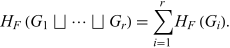
For every fixed field  ,
the fixed-field Haemers number is additive under the graph
union of pairwise vertex-disjoint graphs,
,
the fixed-field Haemers number is additive under the graph
union of pairwise vertex-disjoint graphs,
 |
(4)
|
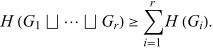
This follows because every fitting matrix for a disjoint union is block diagonal, with one fitting block for each component. Minimizing over fields therefore gives
 |
(5)
|
Equality holds whenever a single field simultaneously attains all the component minima, in particular when every component value is independent of the field.
Since a complete multipartite graph  is perfect and has independence
number
is perfect and has independence
number  ,
,
 |
(6)
|
Consequently, the  -vertex
Turán graph
-vertex
Turán graph  satisfies
![H(T(n,k))=[n/k].](/images/equations/HaemersNumber/NumberedEquation7.svg) |
(7)
|
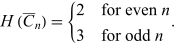
The complement of a cycle graph of order  satisfies
 |
(8)
|
For even  ,
the cycle and its complement are perfect, and
,
the cycle and its complement are perfect, and  . For odd
  , the upper bound follows from
  . For the lower bound, if a fitting matrix of rank
at most two were factored as
. For the lower bound, if a fitting matrix of rank
at most two were factored as  , the zero entries corresponding to consecutive cycle
vertices would force row vectors
, the zero entries corresponding to consecutive cycle
vertices would force row vectors  and
and  of
of  to be proportional. Going around an odd cycle would make all
the
to be proportional. Going around an odd cycle would make all
the  proportional, contradicting the nonzero diagonal entries of
  .
.
