

The Grothendieck group of a commutative monoid  , written additively, is the universal
Abelian group
 receiving a homomorphism
 preserving addition
and zero. Every such homomorphism from
 to an Abelian group
 factors uniquely through a group
homomorphism
 (Weibel 2013, p. 63). Its elements are pairs
 modulo the equivalence
relation
 iff
 for some
 . The group law is
 , and
 . The class
 represents the formal difference
 . For the monoid of isomorphism
classes of complex vector bundles over a
compact Hausdorff space
under Whitney sum, the resulting group
is the zeroth topological
 -group (Atiyah 1989; Weibel 2013, p. 82).
For an exact category  whose isomorphism classes
of objects form a set,
 is generated by those classes
 , with the relation
 for each chosen short
exact sequence
 (Weibel 2013, p. 129). The choice of exact structure matters. For a triangulated
category with a set of isomorphism
classes, the corresponding relation is imposed for each distinguished triangle
 (Weibel 2013,
p. 173).
For a smooth projective variety  over
 ,
let
 be its bounded derived category of coherent
sheaves, and write
 . The Euler pairing on this group
is given by
 |
where  is the
 th
shift and the hom-sets are finite-dimensional vector
spaces that vanish for all but finitely many
 . This pairing is additive in each argument. The numerical
Grothendieck group
 is the quotient group of
 by the classes
 satisfying
 for every
 . It has finite rank
(Bridgeland 2007, pp. 319-320).
A numerical Bridgeland stability condition has a central charge that factors through 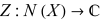 . Its support property requires a norm
on the real vector space
 and a constant
 such that
 |
for every nonzero semistable object  , where
 is its numerical class (Bayer et al. 2016, p. 922).
The norm is defined on the entire real
vector space, but the inequality is required only for classes of semistable objects.
