

A universal property in category theory, also called a universal mapping property, characterizes an object by how morphisms to or from all other objects factor through it. It consists of the existence and uniqueness of a morphism making a specified commutative diagram commute. Any two objects satisfying the same universal property are uniquely isomorphic in a manner compatible with the specified structure.
For example, a category product  with projections
 and
 has the universal property that for every object
 and morphisms
 and
 , there is a unique morphism
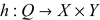 such that
 and
 . Universal constructions can generally be expressed
as initial objects or terminal
objects in a suitable auxiliary category.
In logic, a universal property is a property of individuals shared by every individual (Carnap 1958).
