


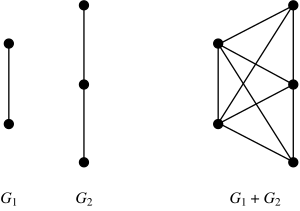
The graph join  of graphs
  and
and  with disjoint sets
  and
and  of vertices and edge sets
  and
and  is the graph union
  together with all the edges
joining
together with all the edges
joining  and
and  (Harary 1994, p. 21). Graph joins
are implemented in the Wolfram Language
as GraphJoin[G1,
G2].
(Harary 1994, p. 21). Graph joins
are implemented in the Wolfram Language
as GraphJoin[G1,
G2].
In particular, if  is the singleton graph, then the graph
corona product
is the singleton graph, then the graph
corona product  is the graph join
  .
.
A complete k-partite graph  is the graph join of empty
graphs on
is the graph join of empty
graphs on  ,
,
 , ... nodes.
A wheel graph is the join of a cycle
graph and the singleton graph. Finally, a
star graph is the join of an empty
graph and the singleton graph (Skiena 1990,
p. 132).
, ... nodes.
A wheel graph is the join of a cycle
graph and the singleton graph. Finally, a
star graph is the join of an empty
graph and the singleton graph (Skiena 1990,
p. 132).
The following table gives examples of some graph joins. Here  denotes an empty graph
(i.e., the graph complement of the complete
graph
denotes an empty graph
(i.e., the graph complement of the complete
graph  ),
),
 a cycle
graph, and
a cycle
graph, and  the singleton graph.
| product | result |
 | complete  -partite
graph -partite
graph  |
 | wheel graph  |
 | star
graph  |
 |  -dipyramidal graph -dipyramidal graph |
 | cone
graph  |
 | fan graph |
 | windmill
graph  |
