TOPICS
Search

Graham's GCD Problem


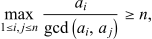
Graham's GCD problem asks whether every set of n distinct positive integers a_1,...,a_n satisfies

 max_(1<=i,j<=n)(a_i)/(gcd(a_i,a_j))>=n,

where gcd is the greatest common divisor (Graham 1970). The maximum is taken over ordered pairs, so interchanging i and j can change the quotient.

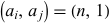
Balasubramanian and Soundararajan (1996) proved the assertion for every n. The bound is sharp for the set {1,...,n}, since every quotient is at most n and the pair (a_i,a_j)=(n,1) attains n.

This is problem 402 in the Erdős problems collection (Bloom 2026).


See also

Erdős Problems, Greatest Common Divisor

Explore with Wolfram|Alpha

References

Balasubramanian, R. and Soundararajan, K. "On a Conjecture of R. L. Graham." Acta Arith. 75, 1-38, 1996. https://doi.org/10.4064/aa-75-1-1-38.Bloom, T. F. "Erdős Problem 402." Accessed Oct. 26, 2026. https://www.erdosproblems.com/402.Graham, R. L. "Problem 5749." Amer. Math. Monthly 77, 775, 1970.

Cite this as:

Weisstein, Eric W. "Graham's GCD Problem." From MathWorld--A Wolfram Resource. https://mathworld.wolfram.com/GrahamsGCDProblem.html

Subject classifications