

A binary Goldbach ring is the quotient ring obtained from the polynomial ring  over a field
 by imposing the quadratic relations
 whenever
 (Nelson 2026). The variables have bidegrees
 , recording the sum and number of primes
represented by a monomial. These relations need not
permit cancellation, so the ring is not automatically the toric quotient obtained
by identifying every pair of monomials of the same bidegree.
Nelson (2026) proved that every map  from the odd primes to any
Abelian group that preserves equal two-prime sums
satisfies
 |
Equivalently, the universal Abelian relation group is  . Including the prime 2 adds an independent generator,
and gives
 , rather than the same affine conclusion on all primes.
The ring also has quantitative graded Betti numbers. Write  for the number of generators in homological position
 , additive weight
 , and polynomial degree
 in its minimal bigraded free resolution.
Each fixed bidegree stabilizes along finite-support truncations, making these numbers
well-defined for the infinite ring. For fixed
 and admissible weights
 , Nelson (2026) obtained
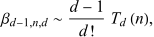 |
where  counts ordered
 -tuples
of odd primes summing to
 , with repetitions allowed. The leading asymptotic holds
over every field, without asserting that individual Betti
numbers are independent of the characteristic. For the finite quotient on odd primes at most
 , with all binary relations retained
and
 variables, the total linear-strand numbers satisfy
 for fixed
 . Keeping only relations whose common sum is at
most
 instead gives the leading coefficient
 .
These results do not prove the binary Goldbach conjecture, connectedness of every binary-relation fiber, or the integral-domain property of the full ring. Nelson (2026) credits GPT-6 Astra with proposals and initial proofs of the principal additive and asymptotic results, subsequently checked and revised by the author.
