

The geometric coefficient of variation is a dimensionless measure of relative statistical dispersion for positive data (Kirkwood
1979). If  is the standard deviation
of the natural logarithms of the observations,
it is defined by
is the standard deviation
of the natural logarithms of the observations,
it is defined by
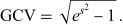 |
It is multiplied by 100 when expressed as a percent.
For a log normal distribution, this quantity equals the ordinary variation coefficient. Unlike the arithmetic variation coefficient, it is naturally associated with multiplicative variation and depends only on the spread of the logarithms, not their mean.
