A geodetic graph is a connected graph with a unique shortest path between every pair of vertices.
Ore (1962) introduced the term and asked for a characterization extending the familiar
property of trees.
The numbers of geodetic graphs on , 2, ... vertices are 1,
1, 2, 4, 10, 23, 66, 185, 586, 1880, 6360, 21975, 78230, 283087, 1043329, ... (OEIS
A337179).
Stober and Weiß (2026) enumerate all biconnected graphs with the geodetic property through 25 vertices,
obtaining 149 in total. Their enumeration also gives connected
counts through 22 vertices and all regular
examples through 32 vertices. Their Stober-Weißgraphs
form a new infinite family obtained from three constituent geodetic pieces by
identifying specified cliques. The smallest member of
this family, ,
has 24 vertices.
Frasser, C. E. "-Geodetic Graphs and Their Application to the Topological Design
of Computer Networks." In Proc. Argentinian Workshop on Theoretical Computer
Science, 28 JAIIO-WAIT'99. pp. 187-203, 1999.Gorovoy, D. and
Zmiaikou, D. "On Graphs with Unique Geoodesics and Antipodes." 19 Nov 2021.
https://arxiv.org/abs/2111.09987.Ore,
O. Theory of Graphs. Providence, RI: Amer. Math. Soc., 1962.Parthasarathy,
K. R. and Srinivasan, N. "Some General Constructions of Geodetic Blocks."
J. Combin. Th.33, 121-136, 1982.Sloane, N. J. A.
Sequence A337179 in "The On-Line Encyclopedia
of Integer Sequences."Stemple, J. G.; and Watkins, M. E.
"On Planar Geodetic Graphs." J. Combin. Th.4, 101-117, 1968.Stober,
F. and Weiß, A. "Geodetic Graphs: Experiments and New Constructions."
Electron. J. Combin.33, P3.64, 2026. https://doi.org/10.37236/13950.


 , 2, ... vertices are 1,
1, 2, 4, 10, 23, 66, 185, 586, 1880, 6360, 21975, 78230, 283087, 1043329, ... (OEIS
A337179).
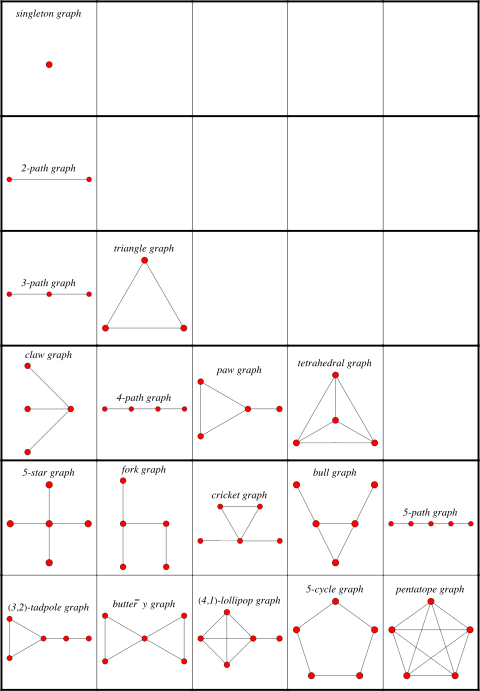
 (Gorovoy and Zmiaikou 2021), odd cycle graphs
 (Gorovoy and Zmiaikou 2021),
lollipop graphs, trees
(Gorovoy and Zmiaikou 2021), triangular snake
graphs, and windmill graphs.
 obtained from three constituent geodetic pieces by
identifying specified cliques. The smallest member of
this family,
 ,
has 24 vertices.

 -Geodetic Graphs and Their Application to the Topological Design
of Computer Networks." In Proc. Argentinian Workshop on Theoretical Computer
Science, 28 JAIIO-WAIT'99. pp. 187-203, 1999.Gorovoy, D. and
Zmiaikou, D. "On Graphs with Unique Geoodesics and Antipodes." 19 Nov 2021.