


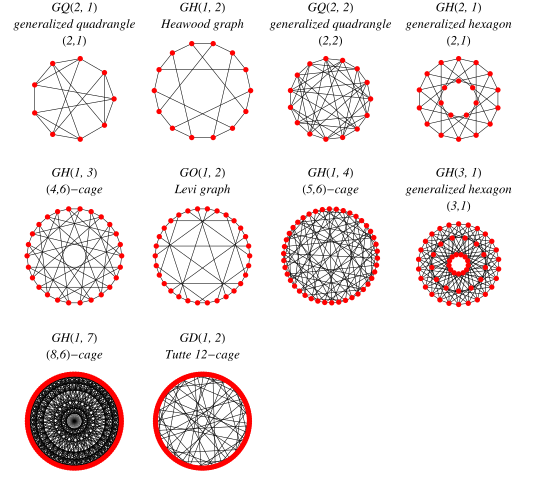
A generalized polygon is an incidence plane satisfying two path conditions. More precisely, let  be an incidence geometry, i.e., a set
with a symmetric, reflexive binary
relation
 , and let
 and
 be elements of
 . An incidence plane is an incidence geometry whose object set
is the disjoint union of two sets
 and
 such that for
 or
 ,
 only if
 . Then a generalized polygon
satisfies, for all
 ,
1. There exists a path of length at most  from
 to
 , and
2. There exists at most one irreducible path of length less than  from
 to
 .
(Feit and Higman 1964).
The incidence graph of a generalized polygon has vertex set  , so it is a bipartite
graph with parts
 and
 . Generalized polygons need not
be regular. For example, the incidence graph of the
generalized quadrangle
 has 27 point vertices
of degree 5 and 45 line vertices of degree
3; in particular, it is neither a regular graph
nor a distance-regular graph, and the unequal
bipartition sizes also prevent it from having a Hamiltonian
path or Hamiltonian cycle (Godsil and Royle
2001, pp. 84-87).
The only cubic generalized polygons are the generalized 2-gon  (utility graph), generalized triangle
 , generalized
quadrangle
 , and generalized
hexagon
 (Feit and Higman 1964, Royle).
