

The generalized Lambert  -function with real parameters
 and
 is a generally multivalued function obtained
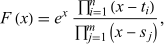
by inverting
 |
(1)
|
where  and
 are nonnegative integers. Here
 is excluded for every
 , and an empty product is
interpreted as 1. For a real value
 , the inverse values are the real
solutions of
 . This definition does not select a particular branch
(Mező and Baricz 2017).
For  ,
 ,
and
 ,
the defining equation is
 , so the inverse values are the real
values of the ordinary Lambert W-function.
For
 ,
the inverse is the natural logarithm
 for
 (Mező and Baricz 2017).
A special case with a quadratic polynomial is
 |
(2)
|
where  ,
 ,
 ,
and
 are real, with
 and
 . The substitution
 gives
 , so the inverse values with
 ,
 ,
 ,
and
 yield
 .
This equation can have three distinct real roots. It
has at most three because the third derivative of
 never vanishes, and Rolle's theorem would force
that derivative to vanish between four distinct real roots (Scott et al. 2014, pp. 43-44).
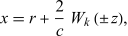
If  ,
 ,
and
 ,
taking both square-root signs gives
 |
(3)
|
where  and
 denotes a branch of the ordinary Lambert
W-function (Scott et al. 2013, p. 77; Maignan and Scott 2016,
p. 46). The plus sign gives a real root for
 .
The minus sign gives real roots iff
 ,
using
 and
 with coincident values at
 .
Equations involving an exponential function and a rational function also motivated earlier work on generalized Lambert functions (Scott and Mann 2006). A generalization of the defining equation does not by itself provide an explicit formula in ordinary Lambert W-functions.

 Function." ACM Commun. Comput. Algebra 50,
45-60, 2016.
 Function." Trans. Amer. Math. Soc. 369,
7917-7934, 2017.
 Function." ACM Commun. Comput. Algebra 47, 75-83, 2013.
 Function." ACM Commun. Comput. Algebra 48,
42-56, 2014.
 Function." 6 Sep 2006.