

The gasoline problem is an inventory scheduling problem in which deliveries may be reordered but demands must be met in a fixed order. Given nonnegative delivery sizes
 ,
 , ...,
 and demands
 ,
 , ...,
 with equal totals, choose a permutation
 of the deliveries to minimize the required
storage capacity (Lorieau 2024). Each delivery precedes the demand in its time slot,
and the initial inventory may be chosen freely.
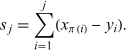
Writing  ,
the inventory relative to its initial value after the
 th demand is
 |
(1)
|
The peaks just after deliveries and the troughs just after demands therefore give the required capacity
 |
(2)
|
The least feasible initial inventory is  , and the optimum capacity is
 .
An iterative rounding algorithm fixes the delivery order one position at a time. At each position, it tries each remaining delivery
and solves a fractional assignment problem by linear
programming, with the chosen prefix fixed. It then chooses a candidate with the
smallest fractional optimum. Lorieau's conjecture
(Lorieau 2024, Conjecture 3.1.1) asks whether this algorithm always gives a capacity
at most twice the optimum when the demands are positive
integers and the deliveries have the two possible sizes 1 and  , where
 is an integer.
MathIsEvenEasier (2026) reported the stronger bound
 |
(3)
|
where  is the initial fractional assignment optimum. The bound
permits every exact choice between tied candidates. For
 , an instance with
 time slots has
 and
 when ties are broken by the original input order.
Thus the claimed exact worst-case approximation ratio for that tie rule is
 , with supremum 2 over
 . When
 , the algorithm is optimal.
The result concerns the positive-integer two-size case and does not settle the corresponding
conjectures for unrestricted delivery sizes or multiple
commodities.
The project reports human-directed proof discovery and Lean formalization by OpenAI Codex using GPT-6 Astra. As of Oct. 5, 2026, recorded Lean builds included the bridge from the fractional assignment problem to the formula used in the proof. Earlier independent kernel checks covered the preceding development, not this added bridge. Independent specialist review of the complete mathematical argument had not been reported (MathIsEvenEasier 2026, VibeMathed 2026).
