

The gamma vector of a polynomial  satisfying
  is the sequence
of coefficients
is the sequence
of coefficients  in its unique expansion
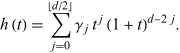 |
Here  is the floor
function. The polynomial has symmetric coefficients,
and the displayed polynomials form a basis
for polynomials with this symmetry of degree at most
is the floor
function. The polynomial has symmetric coefficients,
and the displayed polynomials form a basis
for polynomials with this symmetry of degree at most
 (Horiguchi et al. 2026).
For example,  has gamma vector
  ,
whereas
,
whereas  has gamma vector
  .
Nonnegative polynomial coefficients therefore need
not imply nonnegative gamma coefficients.
.
Nonnegative polynomial coefficients therefore need
not imply nonnegative gamma coefficients.
For a  -dimensional
simple polytope, write
-dimensional
simple polytope, write  for the number of
  -dimensional faces, with
  . The polynomial
  is symmetric by the Dehn-Sommerville
equations. Horiguchi et al. (2026) prove that its gamma vector is nonnegative
for every partitioned permutohedron.
is symmetric by the Dehn-Sommerville
equations. Horiguchi et al. (2026) prove that its gamma vector is nonnegative
for every partitioned permutohedron.
