

The frustration index of a signed graph is the minimum number of edges whose deletion makes every cycle graph positive, where the sign of a cycle graph is the product of its edge signs. A signed graph with this property is called balanced. Equivalently, the frustration index is the minimum number of negative edges among all signings obtained by switching at vertices (Zaslavsky 1998). Switching reverses every sign incident with the chosen graph vertex.
A fully frustrated signing of the hypercube graph  makes every 4-cycle
graph negative. All such signings are switching equivalent, so their common frustration
index is a well-defined number
 . Wang (2026) proved
 |
(1)
|
for every positive integer  . For positive
 divisible by 4 and
 , put
 . Then
 |
(2)
|
The further exact value  follows by proving a matching lower bound for a previously
known construction.
Uniformly in  , Wang (2026) also proved
 |
(3)
|
where  denotes big-O notation. The order of the error
cannot be improved uniformly. The spectral lower bound
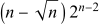 is attained exactly when
 is a power of 4.
