


Freeth's nephroid is a strophoid of a circle with the pole  at the center of the circle
and the fixed point
 on the circumference of
the circle. In the construction illustrated above,
 is a moving point
on the circle, and
 and
 lie on the line
 in opposite directions from
 . The point
 is obtained by moving away from
 , and
 by moving toward
 , in each case through a distance
 . Thus
 , as indicated by
the matching marks. As
 moves around the circle, the two
points together trace Freeth's nephroid. Freeth (1879)
described this and various other strophoids (MacTutor
Archive).

The perpendicular bisector of  cuts the outer boundary of Freeth's nephroid at the upper
point
 illustrated above. The angle
 is
 , so this curve can be
used to construct a regular heptagon.
Freeth's nephroid has polar equation
 |
(1)
|
for  .
The area enclosed by the outer boundary of the curve is
 |
(2)
|
and the total arc length over  is
 |  |  |
(3)
|
 |  |  |
(4)
|
(OEIS A138498), where  ,
 is a complete
elliptic integral of the first kind,
 is a complete
elliptic integral of the second kind, and
 is a complete
elliptic integral of the third kind.
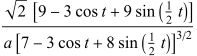
For  , the curvature
and the change in tangential angle from its initial
value are given by
 |  |  |
(5)
|
 |  |  |
(6)
|
where  is the floor function. Here
 , so the absolute tangential
angle is
 . At odd multiples of
 , the value of
 is defined by the limit of
the expression above.
