


The fractional arboricity of a graph  , often denoted
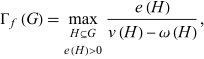
  , is the graph-density parameter defined by
 |
(1)
|
where  ,
,
 ,
and
,
and  are the numbers of vertices, edges, and connected components of
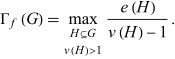
  , respectively. For a connected
graph, this reduces to
, respectively. For a connected
graph, this reduces to
 |
(2)
|
The notion was introduced by Payan (1986).
If  denotes the arboricity of
  , then Nash-Williams' theorem implies that
![Upsilon(G)=[Gamma_f(G)].](/images/equations/FractionalArboricity/NumberedEquation3.svg) |
(3)
|
Indeed, a graph  can be decomposed into at most
  forests if and only if
 |
(4)
|
Thus fractional arboricity is a density refinement of arboricity: it records the extremal edge density of a subgraph before the final rounding step
that produces  .
.
Fractional arboricity is closely related to the graph strength of a graph and plays an important role in graph-decomposition problems, including decompositions of graphs into forests with additional degree restrictions.
