


The pseudoarboricity of a graph  , sometimes denoted
  , is the minimum number of pseudoforests
whose edge sets partition
, is the minimum number of pseudoforests
whose edge sets partition  . Here, a pseudoforest
is a graph each of whose connected components contains at most one cycle.
. Here, a pseudoforest
is a graph each of whose connected components contains at most one cycle.
Hakimi (1965) proved that pseudoarboricity has the density characterization
![p(G)=max_(H subset= G; |V(H)|>=1)[(|E(H)|)/(|V(H)|)],](/images/equations/Pseudoarboricity/NumberedEquation1.svg) |
(1)
|
where the maximum is taken over all nonempty subgraphs  of
of  . In particular,
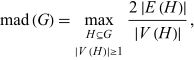
![p(G)=[(mad(G))/2],](/images/equations/Pseudoarboricity/NumberedEquation2.svg) |
(2)
|
where
 |
(3)
|
is the maximum average degree of  .
.
Since every forest is a pseudoforest, pseudoarboricity is bounded above by the usual arboricity  . In fact,
 |
(4)
|
so the arboricity of a graph is always either equal to its pseudoarboricity or greater by  .
.
