

The formal adjoint of a differential operator is the differential expression obtained by moving derivatives between factors using integration by parts and discarding the resulting boundary terms. For
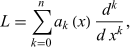 |
the formal adjoint is
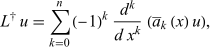 |
where the bar denotes the complex conjugate. For real-valued coefficients, the conjugation can be omitted.
The formal adjoint is a differential expression rather than a complete adjoint operator. The operator domain and boundary conditions must also be specified before an operator adjoint is determined.
