

The Fisher-Tippett-Gnedenko theorem classifies the possible nondegenerate limit distributions of normalized maxima of independent and identically distributed random
variables. Let  ,
,  , ... be independent and identically distributed random variables
with common distribution function
, ... be independent and identically distributed random variables
with common distribution function  , and let
 |
(1)
|
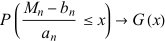
The Fisher-Tippett-Gnedenko theorem states that if there are constants  and
and  such that
 |
(2)
|
at every continuity point of a nondegenerate distribution function  , then, up to a change of location and scale,
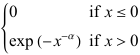
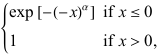
  is one of the three distribution functions
 |  |  |
(3)
|
 |  |  |
(4)
|
 |  | ![{exp[-(-x)^alpha] if x<=0; 1 if x>0,](/images/equations/Fisher-Tippett-GnedenkoTheorem/Inline16.svg) |
(5)
|
where  for
for  and
and  for
for  and
and  .
These are known as the Gumbel, Fréchet,
and Weibull types, respectively. Conversely,
each of the three types can occur as such a limit (Fisher and Tippett 1928, Gnedenko
1943).
.
These are known as the Gumbel, Fréchet,
and Weibull types, respectively. Conversely,
each of the three types can occur as such a limit (Fisher and Tippett 1928, Gnedenko
1943).
The three types can be combined into the generalized extreme value form
![G_xi(x)=exp[-(1+xix)^(-1/xi)]](/images/equations/Fisher-Tippett-GnedenkoTheorem/NumberedEquation3.svg) |
(6)
|
on the set  , with the case
  defined by the limit
 |
(7)
|
Positive, zero, and negative values of  correspond to the Fréchet,
Gumbel, and Weibull
types, respectively.
correspond to the Fréchet,
Gumbel, and Weibull
types, respectively.
The classification is closely related to max-stability. Dividing a large sample into  blocks and taking the maximum within each block leads, after changes of location
and scale, to the functional relation
blocks and taking the maximum within each block leads, after changes of location
and scale, to the functional relation
 |
(8)
|
for suitable  and
and  . The three types above are the possible nondegenerate solutions
arising from this relation. The theorem is therefore the extreme-value analog of
the central limit theorem (Leadbetter et
al. 1983, de Haan and Ferreira 2006).
. The three types above are the possible nondegenerate solutions
arising from this relation. The theorem is therefore the extreme-value analog of
the central limit theorem (Leadbetter et
al. 1983, de Haan and Ferreira 2006).
