


Fisher-Tippett extreme value distributions fall into three types. The type I distributions are the most common and are also called Gumbel distributions. These are distributions
of an extreme order statistic for a distribution
of  elements
  .
.
The Fisher-Tippett distribution corresponding to a maximum extreme value distribution (i.e., the distribution of the maximum  ), sometimes known as the log-Weibull distribution,
with location parameter
), sometimes known as the log-Weibull distribution,
with location parameter  and scale parameter
  is implemented in the Wolfram
Language as ExtremeValueDistribution[alpha,
beta].
is implemented in the Wolfram
Language as ExtremeValueDistribution[alpha,
beta].

It has probability density function and distribution function
 |  |  |
(1)
|
 |  |  |
(2)
|
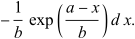
The moments can be computed directly by defining
 |  |  |
(3)
|
 |  |  |
(4)
|
 |  |  |
(5)
|
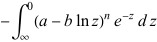
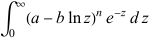
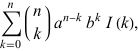
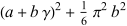
Then the raw moments are
 |  |  |
(6)
|
 |  | ![1/bint_(-infty)^inftyx^nexp((a-x)/b)exp[-e^((a-x)/b)]dx](/images/equations/ExtremeValueDistribution/Inline26.svg) |
(7)
|
 |  |  |
(8)
|
 |  |  |
(9)
|
 |  |  |
(10)
|
 |  |  |
(11)
|
where  are Euler-Mascheroni integrals. Plugging
in the Euler-Mascheroni integrals
are Euler-Mascheroni integrals. Plugging
in the Euler-Mascheroni integrals  gives
gives
 |  |  |
(12)
|
 |  |  |
(13)
|
 |  |  |
(14)
|
 |  |  |
(15)
|
 |  | ![a^4+4a^3bgamma+6a^2b^2(gamma^2+1/6pi^2)+4ab^3[gamma^3+1/2gammapi^2+2zeta(3)]+b^4[gamma^4+gamma^2pi^2+3/(20)pi^4+8gammazeta(3)],](/images/equations/ExtremeValueDistribution/Inline55.svg) |
(16)
|
where  is the Euler-Mascheroni constant and
 is Apéry's constant.
The corresponding central moments are therefore
 |  |  |
(17)
|
 |  |  |
(18)
|
 |  |  |
(19)
|
giving mean, variance, skewness, and kurtosis excess of
 |  |  |
(20)
|
 |  |  |
(21)
|
 |  |  |
(22)
|
 |  |  |
(23)
|
The characteristic function is
 |
(24)
|
where  is the gamma function (Abramowitz and Stegun 1972,
p. 930).
is the gamma function (Abramowitz and Stegun 1972,
p. 930).
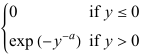
An analog to the central limit theorem states that the asymptotic normalized distribution of  satisfies one of the three distributions
 |  |  |
(25)
|
 |  |  |
(26)
|
 |  | ![{exp[-(-y)^a] if y<=0; 1 if y>0,](/images/equations/ExtremeValueDistribution/Inline89.svg) |
(27)
|
also known as Gumbel-type, Fréchet-type, and Weibull-type distributions, respectively.
The distributions of  are also extreme value distributions. The Gumbel-type distribution
for
are also extreme value distributions. The Gumbel-type distribution
for  is implemented in as GumbelDistribution[alpha,
beta]. The Weibull-type distribution for
is implemented in as GumbelDistribution[alpha,
beta]. The Weibull-type distribution for  is a Weibull distribution. The two-parameter Weibull distribution
is implemented as WeibullDistribution[alpha,
beta].
is a Weibull distribution. The two-parameter Weibull distribution
is implemented as WeibullDistribution[alpha,
beta].
