

The Erdős discrepancy problem asks whether every function  has unbounded sums on homogeneous arithmetic
progressions
 ,
 ,
 ,
 . More precisely, the proposed assertion is
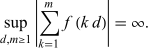 |
Erdős (1957) recorded the problem, and Tao (2016) proved the assertion.
Controlling the sums beginning at 1 does not suffice. For example, the alternating choice  has bounded such sums, but its values on the even positive
integers are all 1, giving arbitrarily large sums when
 .
This is problem 67 in the Erdős problems collection (Bloom 2026).
