


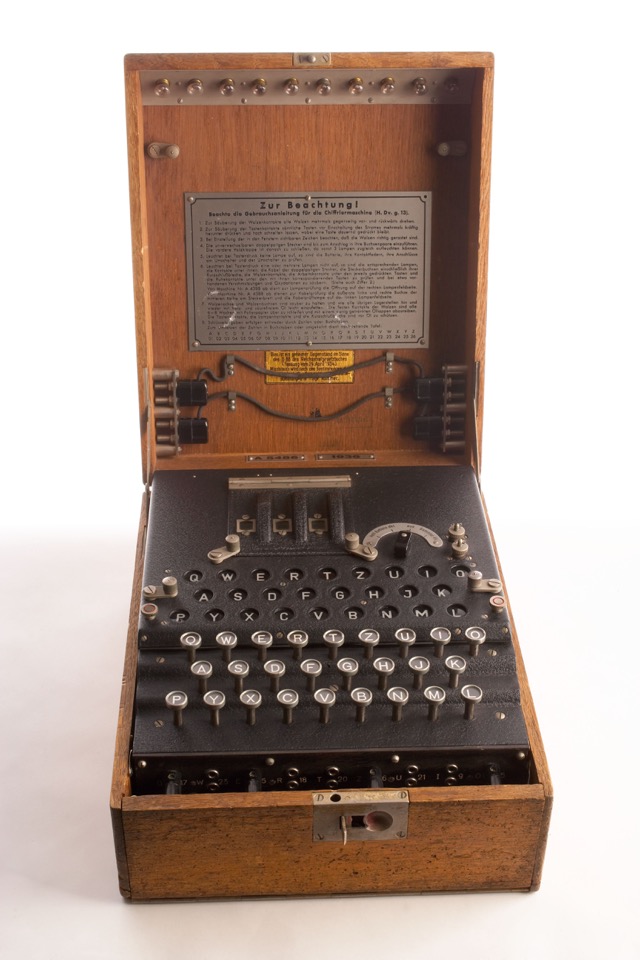
The Enigma machine is an electromechanical device for cryptography whose letter enciphering rule changes as its rotors move. At each fixed rotor state, it acts as a permutation of the 26 letters of the alphabet (Rejewski 1980). The photograph above is courtesy of the Central Intelligence Agency (2011).
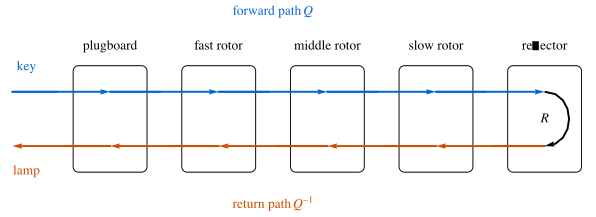
Let  be the permutation carrying a keyboard letter through
the plugboard and rotors to the reflector, and let
 be the reflector's permutation.
The reflector pairs the 26 letters, so
 is a permutation involution
with no fixed points. The return path applies the
inverse permutation
 , giving the enciphering permutation
 |
with function composition evaluated from right to left. The permutations  and
 are conjugate elements,
so
 and
 for every letter
 (Rejewski 1980). No letter enciphers to itself, a restriction
that can rule out proposed alignments of plaintext
and ciphertext. Rotor motion changes
 between keystrokes. Decryption therefore requires reproducing
the same sequence of rotor states, starting from matching initial settings (Grime,
pp. 1-4).

The close-up above shows the keyboard below the lampboard (Central Intelligence Agency 2011).
A plugboard joins letters in pairs, each acting as a transposition, and leaves the remaining letters unchanged. For an alphabet of  letters, the number of arrangements with exactly
 pairs is
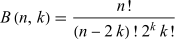 |
for a positive integer  and a nonnegative integer
 with
 . This follows by selecting and ordering
 letters, then removing the ordering of the
 pairs and of the two letters in each pair (Grime, pp. 3-4).
With three ordered rotors chosen from five, 26 initial positions per rotor, and ten plugboard pairs, the number of settings is  (Grime, pp. 3-4).
The reflector and rotor ring settings are held fixed in this count.


