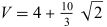
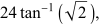
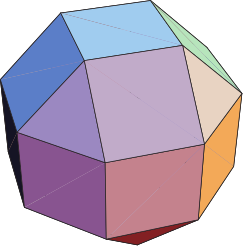
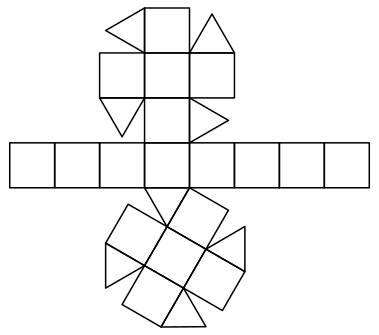
The elongated square gyrobicupola is a nonuniform polyhedron obtained by rotating the bottom third of a small
rhombicuboctahedron (Ball and Coxeter 1987, p. 137). It is also called Miller's
solid, the Miller-aškinuze solid, or the pseudorhombicuboctahedron, and is
Johnson solid.
Although some writers have suggested that the elongated square gyrobicupola should be considered a fourteenth Archimedean solid,
its twist allows vertices "near the equator"
and those "in the polar regions" to be distinguished. Therefore, it is
not a true Archimedean solid like the small
rhombicuboctahedron, whose verticescannot
be distinguished (Cromwell 1997, pp. 91-92).
where the first expression uses the basis of Conway et al. (1999). It can be dissected into the small
rhombicuboctahedron, from which it differs only by relative rotation
of the top and bottom cupolas.
Aškinuze, V. G. "O čisle polupravil'nyh mnogogrannikov." Math. Prosvešč.1, 107-118, 1957.Ball,
W. W. R. and Coxeter, H. S. M. Mathematical
Recreations and Essays, 13th ed. New York: Dover, pp. 137-138, 1987.Conway,
J. H.; Radin, C.; and Sadun, L. "On Angles Whose Squared Trigonometric
Functions Are Rational." Discr. Computat. Geom.22, 321-332, 1999.Coxeter,
H. S. M. "The Polytopes with Regular-Prismatic Vertex Figures."
Phil. Trans. Roy. Soc.229, 330-425, 1930.Cromwell, P. R.
Polyhedra.
New York: Cambridge University Press, pp. 91-92, 1997.Johnson,
N. W. "Convex Polyhedra with Regular Faces." Canad. J. Math.18,
169-200, 1966.Miller, J. C. P. "Polyhedron." Encyclopædia
Britannica, 11th ed..


 .
.