


The elliptic exponential function parametrizes the nonsingular elliptic curve  by a complex argument
 ,
taken modulo its period lattice. Here
 and
 are real and
 .
Its value is a pair
 that inverts the elliptic
logarithm. On a chosen local sheet, the first coordinate satisfies
 |
(1)
|
where the square-root branch agrees with the second coordinate  .
It is implemented in the Wolfram Language as EllipticExp[u,
{a, b}], which returns  together with
 ,
giving a point
 on the elliptic curve
 . The sign of
 selects the sheet of the elliptic
logarithm, whose differential is
 .


The top plot above shows  (red),
 (violet), and
 (blue) for
 .
The other plots show
 in the complex plane.


The plots above show  in the complex plane for
 .
As can be seen from the plots, the elliptic exponential function is doubly periodic in the complex plane.
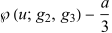
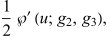
For a nonsingular elliptic curve, the pair has the Weierstrass elliptic function representation
 |  |  |
(2)
|
 |  |  |
(3)
|
where  and
 . Thus
 and
 ,
so the second coordinate distinguishes the two sheets. The arithmetic-geometric
mean also gives an efficient way to evaluate this function and the elliptic
logarithm (Grayson 1989).
