

An elite prime is an odd prime  for which all sufficiently large Fermat
numbers
 are quadratic nonresidues modulo
 (Aigner 1986). The first elite primes are 3, 5, 7, 41, 15361,
23041, 26881, ... (OEIS A102742).
If  counts elite primes at most
 , Taheri and Saleh (2026) proved
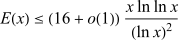 |
as  . Under the generalized
Riemann hypothesis for all Dirichlet L-functions,
they also obtained
 , where
 denotes big-O
notation. Their AI-generated Lean formalization takes the analytic estimates
used in the proofs, including consequences of the generalized
Riemann hypothesis, as explicit hypotheses.
For an odd prime  ,
write its multiplicative order of 2 as
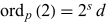 with
 odd. The sequence
 modulo
 is periodic from
 onward, with period equal to the multiplicative
order of 2 modulo
 , interpreted as 1 when
 . Thus testing whether the Fermat
numbers in this single period are all quadratic
nonresidues decides eliteness. For every elite prime other than 3 and 5,
 and this period is even (Aigner
1986, Taheri and Saleh 2026).
