

The Dyson-Schwinger equations, also called the Schwinger-Dyson equations, are an infinite hierarchy of coupled functional differential equations and integral equations satisfied by the Green's functions of a quantum field theory (Dyson 1949, Schwinger 1951ab). They are the quantum equations of motion and follow formally from invariance of a functional integral under the change of variables theorem. This step is called functional integration by parts: it is the functional-integral analog of ordinary integration by parts, with a field as the integration variable and a functional derivative in place of an ordinary derivative. In both cases, the boundary term is assumed to vanish.
In Euclidean conventions for bosonic fields, let ![S[phi]](/images/equations/Dyson-SchwingerEquations/Inline1.svg) be the classical action, i.e., the functional whose stationary
points give the classical equations of motion, and let
be the classical action, i.e., the functional whose stationary
points give the classical equations of motion, and let  be an external source coupled linearly to the field. Square
brackets in expressions such as
be an external source coupled linearly to the field. Square
brackets in expressions such as ![S[phi]](/images/equations/Dyson-SchwingerEquations/Inline3.svg) indicate dependence on the entire field configuration,
rather than on the value of an ordinary function at one point. The generating functional
indicate dependence on the entire field configuration,
rather than on the value of an ordinary function at one point. The generating functional
 ,
mean field
,
mean field  ,
and quantum effective action
,
and quantum effective action  are defined by
![Z[J]](/images/equations/Dyson-SchwingerEquations/Inline7.svg) |  | ![intDphiexp[-S[phi]+J_iphi_i]](/images/equations/Dyson-SchwingerEquations/Inline9.svg) |
(1)
|
 |  | ![(deltalnZ[J])/(deltaJ_i)=<phi_i>_J](/images/equations/Dyson-SchwingerEquations/Inline12.svg) |
(2)
|
![Gamma[Phi]](/images/equations/Dyson-SchwingerEquations/Inline13.svg) |  | ![J_iPhi_i-lnZ[J],](/images/equations/Dyson-SchwingerEquations/Inline15.svg) |
(3)
|
where ![Z[J]](/images/equations/Dyson-SchwingerEquations/Inline16.svg) is a functional integral. The notation
is a functional integral. The notation  is its formal functional integration measure over field
configurations and is conventionally written directly after the integral sign. Here
is its formal functional integration measure over field
configurations and is conventionally written directly after the integral sign. Here
 is the source-dependent expectation value of
the field and
is the source-dependent expectation value of
the field and  is the Legendre
transformation of
is the Legendre
transformation of  . Repeated field labels include the appropriate summation
or integration. Functional integration by parts then gives the master relation
. Repeated field labels include the appropriate summation
or integration. Functional integration by parts then gives the master relation
![(deltaGamma[Phi])/(deltaPhi_i)=J_i=<(deltaS[phi])/(deltaphi_i)>_J.](/images/equations/Dyson-SchwingerEquations/NumberedEquation1.svg) |
(4)
|
Repeated functional derivatives of this identity generate equations relating Green's functions of different orders. The resulting hierarchy is exact but generally does not close at any finite order, so applications usually replace it by a truncated system.
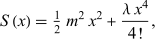
For example, the zero-dimensional scalar model with
 |
(5)
|
has generating integral
![Z(J)=int_(-infty)^inftyexp[-S(x)+Jx]dx.](/images/equations/Dyson-SchwingerEquations/NumberedEquation3.svg) |
(6)
|
Integration by parts gives the Dyson-Schwinger equation
 |
(7)
|
which illustrates how an interaction of degree four couples derivatives of different orders.
