TOPICS
Search

Dual Number


A dual number over a field k is an element of the quotient ring k[epsilon]/(epsilon^2). Every dual number has a unique expression a+bepsilon, where a,b in k and epsilon denotes the nonzero class satisfying epsilon^2=0 (Milne 2024, p. 90). Addition is componentwise, and multiplication is given by

 (a+bepsilon)(c+depsilon)=ac+(ad+bc)epsilon.

Thus epsilon is a nonzero nilpotent element, so this ring is not a reduced ring and is not a field.

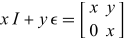
For k=R, a dual number x+epsilony can be represented by matrices. Take epsilon=[0 1; 0 0] and interpret the scalar x as xI, where I is the identity matrix. This gives xI+yepsilon=[x y; 0 x], with epsilon^2=0. A dual number is a ring unit iff a!=0, in which case its multiplicative inverse is

 (a+bepsilon)^(-1)=a^(-1)-ba^(-2)epsilon.

See also

Nilpotent Element, Quotient Ring, Reduced Ring

Explore with Wolfram|Alpha

References

Brand, L. Vector and Tensor Analysis. New York: Wiley, 1947.Milne, J. S. Algebraic Geometry. Version 6.10, Nov. 11, 2024. https://www.jmilne.org/math/CourseNotes/AG.pdf.

Referenced on Wolfram|Alpha

Dual Number

Cite this as:

Weisstein, Eric W. "Dual Number." From MathWorld--A Wolfram Resource. https://mathworld.wolfram.com/DualNumber.html

Subject classifications