

Discordant permutations are two permutations of the same set that differ at every position. For permutations
of  ,
write
 and
 .
Here
 and
 denote the entries in position
 of the respective permutations,
so the condition is
 |
for every  (Wahid 2001, p. 57). For example, the permutations
 and
 are discordant, although neither is a derangement.
A permutation discordant with the identity permutation is a derangement. More generally,
 and
 are discordant iff
 is a derangement.
Consequently, the number of permutations discordant
with any fixed permutation of
 elements is
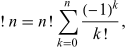 |
where  is the subfactorial and
 is the factorial (Wahid 2001,
pp. 57-58). More generally, the partial derangement
counts enumerate permutations agreeing with a fixed
reference permutation in exactly
 positions.
For  ,
the reduced ménage number
 of the married couples
problem counts permutations discordant with both
the identity permutation and the cyclic
permutation
 modulo
 .
Thus the two forbidden positions are expressed by
 and
 modulo
 (Wahid 2001, p. 58).

 ." Revista de Matemática: Teoría y Aplicaciones 8,
47-62, 2001.