A derangement is a permutation of distinct objects in which none remains in its original position. For example, the only derangements
of are and , so . Similarly, the derangements of are , , , , , , , , and . Derangements are permutations
without fixed points (i.e., having no cycles
of length one). The derangements of a list of distinct elements, relative to their positions in that list,
can be computed in the Wolfram Language
using
The derangement problem was formulated by P. R. de Montmort in 1708, and solved by him in 1713 (de Montmort 1713-1714). Nicholas Bernoulli also solved
the problem using the inclusion-exclusion
principle (de Montmort 1713-1714, p. 301; Bhatnagar 1995, p. 8).
Derangements are also called rencontres numbers (named after rencontres solitaire) or complete permutations. The number of derangements of distinct elements is the subfactorial. For integers, it is given by
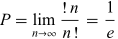
For a uniformly random permutation of distinct objects, the probability
that none remains in its original position is . As increases, this probability approaches
(4)
(Wells 1986, p. 27). In fact, the probability is very close to already even for as few as four points.
for , with and (Skiena 1990, p. 33). For , 2, ..., the first few are 0, 1, 2, 9, 44, 265, 1854, ...
(OEIS A000166). The recurrence can be solved
exactly, although the sequence of cannot be expressed as a fixed number of hypergeometric
terms (Petkovšek et al. 1996, pp. 157-160; Koepf 1998, p. 159).


 are
are  and
and  , so
, so  . Similarly, the derangements of
  are
are  ,
,  ,
,  ,
,  ,
,  ,
,  ,
,  ,
,  , and
, and  . Derangements are permutations
without fixed points (i.e., having no cycles
of length one). The derangements of a list of
. Derangements are permutations
without fixed points (i.e., having no cycles
of length one). The derangements of a list of  distinct elements, relative to their positions in that list,
can be computed in the Wolfram Language
using
distinct elements, relative to their positions in that list,
can be computed in the Wolfram Language
using
 distinct elements is the subfactorial
  . For integers
  , it is given by


 is the incomplete
gamma function. For
is the incomplete
gamma function. For  ,
it also equals
,
it also equals
![!n=[(n!)/e],](/images/equations/Derangement/NumberedEquation1.svg)
 is the usual factorial and
 ![[x]](/images/equations/Derangement/Inline28.svg) is the nearest integer
function.
is the nearest integer
function.
 distinct objects, the probability
that none remains in its original position is
distinct objects, the probability
that none remains in its original position is  . As
. As  increases, this probability approaches
 already even for as few as four points.
 satisfy the recurrence
relations
satisfy the recurrence
relations
![d(n)=(n-1)[d(n-1)+d(n-2)]](/images/equations/Derangement/NumberedEquation3.svg)
 and
and

 , with
  and
and  (Skiena 1990, p. 33). For
  , 2, ..., the first few are 0, 1, 2, 9, 44, 265, 1854, ...
(OEIS A000166). The recurrence can be solved
exactly, although the sequence of
, 2, ..., the first few are 0, 1, 2, 9, 44, 265, 1854, ...
(OEIS A000166). The recurrence can be solved
exactly, although the sequence of  cannot be expressed as a fixed number of hypergeometric
terms (Petkovšek et al. 1996, pp. 157-160; Koepf 1998, p. 159).
cannot be expressed as a fixed number of hypergeometric
terms (Petkovšek et al. 1996, pp. 157-160; Koepf 1998, p. 159).

 Extensions." PhD thesis. Columbus, OH: Ohio State
University, 1995.Comtet, L. "The 'Problème des Rencontres.'
" §4.2 in
Extensions." PhD thesis. Columbus, OH: Ohio State
University, 1995.Comtet, L. "The 'Problème des Rencontres.'
" §4.2 in