TOPICS
Search

Delannoy Polynomial


The Delannoy polynomial
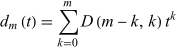
 d_m(t)=sum_(k=0)^mD(m-k,k)t^k

collects Delannoy numbers along an antidiagonal of their array. Here D(a,b) counts lattice paths from (0,0) to (a,b) with steps (1,0), (0,1), and (1,1) (Wang et al. 2019).

The first polynomials are d_0(t)=1, d_1(t)=1+t, d_2(t)=1+3t+t^2, and d_3(t)=1+5t+5t^2+t^3. They satisfy

 d_m(t)=(1+t)d_(m-1)(t)+td_(m-2)(t) for m>=2.

Their coefficients are symmetric, and all their zeros are negative real numbers (Wang et al. 2019).

Bayer et al. (2026) relate products of these polynomials to face enumeration for independence complexes of planar ternary graphs.


See also

Delannoy Number, Independence Complex, Lattice Path, Ternary Graph

Explore with Wolfram|Alpha

References

Bayer, M.; Danner, R.; Holleben, T.; Kramer, M.; and Yang, Y. "Planar Ternary Graphs, Flag Spheres, and Delannoy Polynomials." Electron. J. Combin. 33, P3.66, 2026. https://doi.org/10.37236/14802.Wang, Y.; Zheng, S.-N.; and Chen, X. "Analytic Aspects of Delannoy Numbers." Disc. Math. 342, 2270-2277, 2019.

Cite this as:

Weisstein, Eric W. "Delannoy Polynomial." From MathWorld--A Wolfram Resource. https://mathworld.wolfram.com/DelannoyPolynomial.html

Subject classifications


