

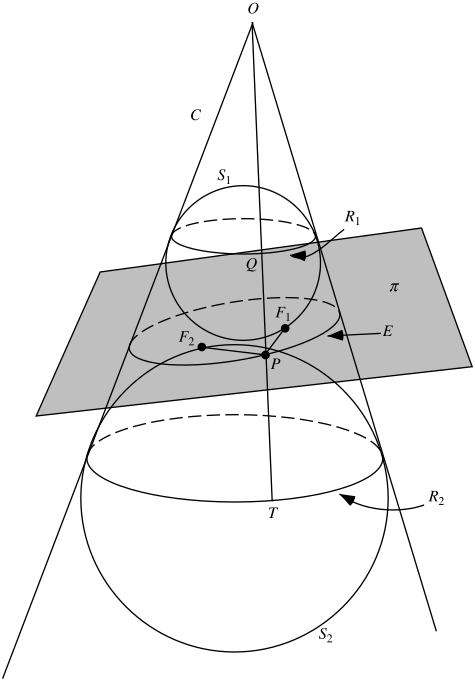
Dandelin spheres are spheres tangent internally to a cone and also to a plane intersecting the cone. For an elliptical section, the two spheres lie on opposite sides of the intersecting plane.
The spheres can be used to show that the intersection of the plane with the cone is an ellipse. This argument is informally known as the ice cream cone proof. It proves that the conic section definition of an ellipse agrees with the focal definition in which the sum of the distances from a point to two fixed foci is constant.
Let  be a plane intersecting a right circular cone
with vertex
 in the curve
 . Call the spheres tangent
to the cone and the plane
 and
 , and the circles on which
the spheres are tangent to
the cone
 and
 . Pick a line along the cone
which intersects
 at
 ,
 at
 , and
 at
 . Call the points on the plane
where the spheres are tangent
 and
 . The two tangent segments from
 to each sphere have the same length,
so
 |
(1)
|
 |
(2)
|
Therefore,
 |
(3)
|
which is a constant independent of  , so
 is an ellipse with semimajor
axis
 .
For a hyperbola, the two spheres lie in opposite nappes of the cone. The cutting plane meets a generator line outside the segment between
the two circles of tangency. With the same notation,  . The length
 is constant because it is the sum of the two fixed slant
distances from the vertex to the corresponding circles (Zwikker 1963, p. 120).
For a parabola, the cutting plane is parallel to a generator and there is one Dandelin sphere. Let  be its point of tangency with the cutting plane, and let
 be the line where the cutting plane
meets the plane of the circle of tangency. For any point
 on the parabola, let
 be the point where the generator through
 meets the circle. The segment
 and the perpendicular in the cutting plane from
 to
 make the same angle with the plane of the circle. Both span
the same perpendicular distance to that plane, so their lengths are equal. Since
 by tangency,
 and
 are the focus and directrix,
respectively (Zwikker 1963, p. 126).
