


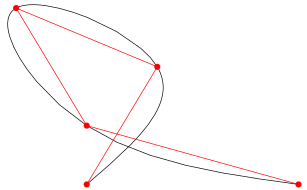
A cubic spline is a spline constructed of piecewise third-order polynomials which pass through a set of  control points. The second derivative
of each polynomial is commonly set to zero at the
endpoints, since this provides a boundary condition that completes the system of
control points. The second derivative
of each polynomial is commonly set to zero at the
endpoints, since this provides a boundary condition that completes the system of
 equations. This produces a so-called
"natural" cubic spline and leads to a simple tridiagonal
system which can be solved easily to give the coefficients of the polynomials. However,
this choice is not the only one possible, and other boundary conditions can be used
instead.
equations. This produces a so-called
"natural" cubic spline and leads to a simple tridiagonal
system which can be solved easily to give the coefficients of the polynomials. However,
this choice is not the only one possible, and other boundary conditions can be used
instead.
Cubic splines are implemented in the Wolfram Language as BSplineCurve[pts, SplineDegree -> 3].
Consider 1-dimensional spline for a set of  points
 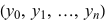 . Following Bartels et al. (1998, pp. 10-13),
let the
. Following Bartels et al. (1998, pp. 10-13),
let the  th
piece of the spline be represented by
th
piece of the spline be represented by
 |
(1)
|
where  is a parameter
 ![t in [0,1]](/images/equations/CubicSpline/Inline7.svg) and
and  , ...,
  . Then
 |  |  |
(2)
|
 |  |  |
(3)
|
Taking the derivative of  in each interval then gives
 |  |  |
(4)
|
 |  |  |
(5)
|
Solving (2)-(5) for  ,
,  ,
,
 , and
, and  then gives
 |  |  |
(6)
|
 |  |  |
(7)
|
 |  |  |
(8)
|
 |  |  |
(9)
|
Now require that the second derivatives also match at the points, so
 |  |  |
(10)
|
 |  |  |
(11)
|
 |  |  |
(12)
|
 |  |  |
(13)
|
for interior points, as well as that the endpoints satisfy
 |  |  |
(14)
|
 |  |  |
(15)
|
This gives a total of  equations for the
  unknowns. To obtain two more conditions, require that the
second derivatives at the endpoints be zero, so
unknowns. To obtain two more conditions, require that the
second derivatives at the endpoints be zero, so
 |  |  |
(16)
|
 |  |  |
(17)
|
Rearranging all these equations (Bartels et al. 1998, pp. 12-13) leads to the following beautifully symmetric tridiagonal system
![[2 1 ; 1 4 1 ; 1 4 1 ; 1 4 1 ; | ... ... ... ... ... ...; 1 4 1; 1 2][D_0; D_1; D_2; D_3; |; D_(n-1); D_n]=[3(y_1-y_0); 3(y_2-y_0); 3(y_3-y_1); |; 3(y_(n-1)-y_(n-3)); 3(y_n-y_(n-2)); 3(y_n-y_(n-1))].](/images/equations/CubicSpline/NumberedEquation2.svg) |
(18)
|
If the curve is instead closed, the system becomes
![[4 1 1; 1 4 1 ; 1 4 1 ; 1 4 1 ; | ... ... ... ... ... ...; 1 4 1; 1 1 4][D_0; D_1; D_2; D_3; |; D_(n-1); D_n]=[3(y_1-y_n); 3(y_2-y_0); 3(y_3-y_1); |; 3(y_(n-1)-y_(n-3)); 3(y_n-y_(n-2)); 3(y_0-y_(n-1))].](/images/equations/CubicSpline/NumberedEquation3.svg) |
(19)
|
