


Cube packing asks for the smallest cube that can contain  unit cubes
with arbitrary orientations and pairwise disjoint interiors.
Let
 denote its side length. Comparing
volumes and arranging the unit
cubes in a cubic lattice gives
 |
where  is the ceiling function. In particular,
 for every positive integer
 .
For  , the trivial construction
starts with eight unit cubes in a
 cubic lattice
arrangement and removes
 of them. The containing cube has side length 2, which is
the smallest known for every
 in this range (Friedman 2026).
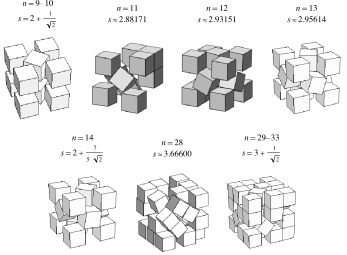
The nontrivial best known packings for  as of October 2026 are illustrated above and listed
below, together with their discoverers and discovery dates (Friedman 2026). The illustrations
are reproduced from Friedman's GitHub repository. The panels labeled 9-10 and 29-33
show the configurations with 10 and 33 cubes, respectively,
from which cubes may be removed to obtain the other orders.
The decimal side lengths are approximate reported values, and optimality is not asserted.
For the remaining positive values
 , the best known construction is the cubic
lattice arrangement with side length
 (Friedman 2026).
 | exact side length | approximate side length | discoverer | date |
| 9 |  |  | E. Friedman | 1998 |
| 10 |  |  | E. Friedman | 1998 |
| 11 |  | S. Sønderland | Oct. 2026 | |
| 12 |  | Y. Nakajima | Oct. 2026 | |
| 13 |  | R. Hayes | Oct. 2026 | |
| 14 |  |  | E. Friedman | 1998 |
| 28 |  | H. Nakano | Oct. 2026 | |
| 29-33 |  |  | E. Friedman | 1998 |
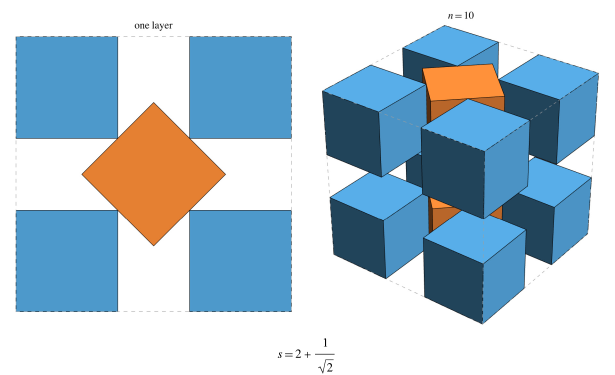
The packing of 10 unit cubes illustrated above consists of two horizontal layers, each with four corner cubes and
a central cube rotated through  about a vertical axis. The left panel shows the square packing in one layer. Removing any cube
gives a packing of nine unit cubes in the same containing
cube.
