

A crossing family in a finite planar point set  in general position, with
no three collinear points, is a collection of line
segments with endpoints in
 whose every pair intersects away from the endpoints of both
segments. Shared endpoints do not count as crossings (Aronov et al. 1994).
Orthaber and Schnider (2026) proved that every such  -point set contains a crossing family of size at least
 |
where  is the floor function. This gives an explicit universal
linear lower bound, with asymptotic coefficient
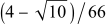 . The geometric notion differs from crossing
families of sets in combinatorial optimization.
Let  be the largest crossing-family size and
 the number of crossings in the complete straight-line drawing
on
 .
Orthaber and Schnider (2026) also proved, for
 ,
 |
The count  belongs to the fixed drawing, rather than being the minimum
over all drawings in the rectilinear crossing
number.
