

A crescent configuration is a set of  points in Euclidean space
with exactly
 distinct interpoint distances whose unordered-pair multiplicities, in some ordering,
are 1, 2, ...,
 .
In dimension
 ,
the general-position convention requires no
 points in a hyperplane
and no
 points on a hypersphere. The
distances need not be numerically ordered by their multiplicities (Burt et al.
2016).
For planar configurations, the conditions are no three collinear points and no four concyclic points. Their existence for arbitrary  is Erdős
problem 217.
Chen (2026) constructed three-dimensional crescent configurations for every  using
 |
where  .
Pairs with index difference
 have squared distance
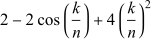 |
and multiplicity  . These distances increase with
 , and the configuration has no four coplanar
or five cospherical points. Integer-coordinate constructions
are also supplied. This three-dimensional result leaves the planar problem open.
Chen (2026) reports GPT-5.5 Pro assistance in searching for the constructions.
