

A covering code of radius  is a code
 of length
 over an alphabet of size
 such that every word is at Hamming
distance at most
 from some codeword in
 . The least such
 is its covering radius, and
 denotes the smallest possible number of codewords
in a covering code of radius at most
 .
The covering density is
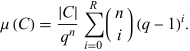 |
It is at least one, with equality for a perfect code.
Maharaj (2026) obtained  for every odd integer
 and
 , using quaternary Preparata
codes. In particular, the octacode gives
 , where the upper bound improves 352.
A separate construction gives
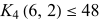 , improving 52. Maharaj (2026) states that Claude
assisted with the searches and proof and that independent programs verified the computational
claims.
