

A core partition with modulus  , or
 -core partition, is a partition
none of whose hook lengths is divisible by the positive
integer
 . The hook
length of a box in its Ferrers diagram is
one plus the number of boxes to its right in the same row and below it in the same
column. A simultaneous
 -core
partition is both an
 -core
and a
 -core.
For example,  has hook lengths 3, 1, and 1, so it is a 2-core but
not a 3-core. For relatively prime positive integers
 , the number of simultaneous core partitions, including
the empty partition, is
 |
(Anderson 2002). For  ,
 , the two are the empty partition
and
 .
A corner is a box whose deletion still leaves a Ferrers diagram. Its count is the number of distinct parts. Cho et al. (2026)
give formulas and bijections for self-conjugate
partitions that are simultaneously  -core, refined by their number of corners.
Aydemir (2026) gave formulas for the largest size and length of a simultaneous  -core with distinct parts for every
relatively prime pair
 . Size is the sum of the parts,
whereas length is the number of parts. For the maximum length, suppose
 and run the Euclidean
algorithm on
 until the first remainder 1. If
 is the preceding remainder, back-substitution gives
 and
 with
 ,
 , and
 , with
 when
 (Aydemir 2026). Put
 and
 . The maximum length
is
 when
 is odd and
 , and
 otherwise, where
 is the floor function.
For example, the maximum length of a distinct-part
 -core is 5 and its maximum size is 24.
Removing rim hooks of length  from a partition
 until none remain leaves its unique
 -core
 . The
 -quotient is an ordered
 -tuple of partitions
 obtained from the residue
classes modulo
 in the abacus representation. Their sizes satisfy
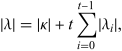 |
where  denotes the sum of the parts of
 (Garvan et al. 1990). Jacon (2026) gives a corresponding
size formula for charged multipartitions with additional terms depending on the charges.

 - and
 -Core." Disc. Math. 248, 237-243, 2002.
 -Core Partitions." Elec.
J. Combin. 33, P3.53, 2026.
 -Cores." Invent. Math. 101, 1-17, 1990.