

A contravariant tensor of tensor rank  is a tensor of type
  , whose components have
  upper indices and transform like a product
of
upper indices and transform like a product
of  vector components. The rank-1 case is an ordinary vector,
such as a tangent vector to a curve.
On a finite-dimensional vector space
vector components. The rank-1 case is an ordinary vector,
such as a tangent vector to a curve.
On a finite-dimensional vector space  , a contravariant tensor is an element of the tensor
product
, a contravariant tensor is an element of the tensor
product  .
On a manifold,
.
On a manifold,  is the tangent space at the
point under consideration. Rank 0 gives a scalar.
is the tangent space at the
point under consideration. Rank 0 gives a scalar.
For a tangent vector expressed in a coordinate vector basis,
 |
(1)
|
repeated upper and lower indices are summed using Einstein summation. Under a smooth invertible change of coordinates
from  to
to  ,
the chain rule gives
,
the chain rule gives
 |  |  |
(2)
|
 |  |  |
(3)
|
Thus the components change inversely to the vector basis, leaving the vector itself unchanged. For example, under
the one-dimensional rescaling  , the component becomes
  , while the vector basis
element
, while the vector basis
element  is half of
  .
.
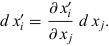
Writing 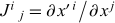 for the Jacobian matrix, the rank-1 transformation is
 |
(4)
|
For a contravariant tensor of tensor rank  , there is one such factor for each index,
 |
(5)
|
In particular, contravariant four-vectors transform under a Lorentz transformation as
 |
(6)
|
A covector instead has lower-index components and is a rank-1 covariant tensor. A nondegenerate metric tensor identifies covectors with vectors by index raising,
 |
(7)
|
where  is the matrix inverse of
  . This identification uses the chosen metric
tensor and is not part of the definition of a contravariant tensor.
. This identification uses the chosen metric
tensor and is not part of the definition of a contravariant tensor.
In an orthonormal basis of Euclidean space,  ,
so corresponding upper- and lower-index components have equal numerical values. Transformations
between such orthonormal bases are orthogonal
transformations, for which the matrix inverse
is the transpose. This is the setting of Cartesian
tensors in any dimension. In general coordinates,
the distinction remains important even in two or three dimensions. Both kinds of
indices occur in a mixed tensor.
,
so corresponding upper- and lower-index components have equal numerical values. Transformations
between such orthonormal bases are orthogonal
transformations, for which the matrix inverse
is the transpose. This is the setting of Cartesian
tensors in any dimension. In general coordinates,
the distinction remains important even in two or three dimensions. Both kinds of
indices occur in a mixed tensor.
