

A check digit is a checksum represented by one symbol and included in an identifier to help detect errors. It is calculated from the data digits, rather than carrying independent identification information. Examples occur in UPC and ISBN.
For a common decimal scheme, let  be the data digits, indexed
from right to left. Set
 when
 is odd
and
 when
 is even. The check digit appended
on the right is
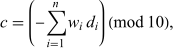 |
where  denotes the common
residue of
 modulo
 .
Thus,
 and
 is divisible
by 10 (GS1).
Since 1 and 3 are relatively prime to 10, changing any single digit, including  , makes
 no longer divisible
by 10. However, swapping adjacent unequal digits leaves
this sum unchanged modulo 10 iff
their values differ by 5. A successful check therefore does not guarantee that the
identifier is free of errors.
