where
and primes denote derivatives with respect to . The numerals I, II, and III designate classes in Chazy's
classification of third-order ordinary
differential equations (Chazy 1911, Sasano 2010). Canonical reduced forms for
classes I and II are
(2)
(3)
Besides the constant solutions, Chazy III has the family
(4)
where
is arbitrary. These solutions exhibit a pole whose location
depends on the choice of . For generic complex initial
conditions, solutions have a movable natural
boundary (Clarkson and Olver 1996).
Another construction comes from the Darboux-Halphen system. If
solves that system, then solves the Chazy equation (Ablowitz et
al. 1998).
Ablowitz, M. J.; Chakravarty, S.; and Halburd, R. "The Generalized Chazy Equation and Schwarzian Triangle Functions." Asian J. Math.2,
619-624, 1998. https://doi.org/10.4310/AJM.1998.v2.n4.a1.Chazy,
J. "Sur les équations différentielles du troisième ordre
et d'ordre supérieur dont l'intégrale générale a ses
points critiques fixes." Acta Math.34, 317-385, 1911. https://doi.org/10.1007/BF02393131.Clarkson,
P. A. and Olver, P. J. "Symmetry and the Chazy Equation." J.
Differential Equations124, 225-246, 1996. https://doi.org/10.1006/jdeq.1996.0008.Sasano,
Y. "Studies on the Chazy Equations." 17 Oct 2010. https://arxiv.org/abs/0708.3537v16.


 and primes denote derivatives with respect to
 . The numerals I, II, and III designate classes in Chazy's
classification of third-order ordinary
differential equations (Chazy 1911, Sasano 2010). Canonical reduced forms for
classes I and II are



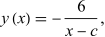
 is arbitrary. These solutions exhibit a pole whose location
depends on the choice of
 . For generic complex initial
conditions, solutions have a movable natural
boundary (Clarkson and Olver 1996).
 solves that system, then
 solves the Chazy equation (Ablowitz et
al. 1998).
