


A central triangle is a triangle specified relative to a reference triangle by one of the following three trilinear vertex matrix constructions.
For type 1, let each of  and
 be a triangle
center function or the zero function, and let
one of the following three conditions hold.
1. The degree of homogeneity of  equals that of
 .
2.  is the zero function and
 is not the zero function.
3.  is the zero function and
 is not the zero function.
Also define three points with the following trilinear coordinates.
 |  |  |
(1)
|
 |  |  |
(2)
|
 |  |  |
(3)
|
Then  is said to be an
 -central
triangle of type 1, and any triangle
 for which these equations hold for some choice
of triangle center functions is called a central triangle of type 1. Such a triangle
is completely determined by its first vertex
 , but has complete trilinear
vertex matrix given by
 |
(4)
|
If  ,
then
 and the triangle degenerates to the triangle center
 (Kimberling 1998, p. 54). Other
choices can also give degenerate configurations when
the trilinear vertex matrix is a singular
matrix. Cevian and anticevian
triangles are both of type 1.
If the symmetry condition on  is relaxed so that
 , then the resulting triangle determined by
 and
 is known as an
 -central triangle of type 2 and has trilinear
vertex matrix
 |
(5)
|
Pedal and antipedal triangles are both of type 2.
Given only a single center function  , then the
 -central triangle of type 3 is the degenerate triangle with
collinear vertices given by trilinear vertex
matrix
 |
(6)
|
This "triangle" is also called the cocevian triangle of the center  (Kimberling
1998, p. 54).
All triangle centers of an equilateral central triangle degenerate into a single center of the reference triangle.
The following table compares central triangles. Here  ,
 , and
 are the side lengths of the
reference triangle,
 is its semiperimeter,
and
 ,
 , and
 also denote its angles. The last
column gives the trilinear coordinates of
the first polygon vertex
 ; the other two are obtained by cyclically
permuting the vertices, side lengths,
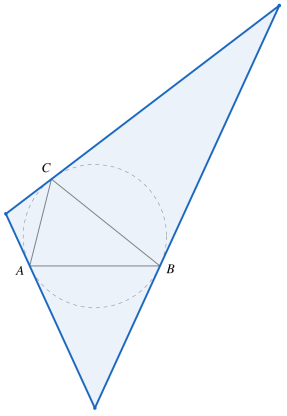
angles, and coordinate positions. The drawings use the
acute triangle with Cartesian
coordinates
 ,
 , and
 , shown in gray, with the derived triangle
in blue. Each drawing is independently scaled. The orthic
triangle and tangential triangle rows
assume that no angle of the reference
triangle is a right angle.
| representative | triangle | construction | first vertex  |

| medial triangle | midpoints of the sides |  |
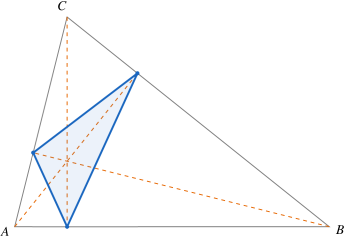
| orthic triangle | perpendicular feet of the altitudes |  |
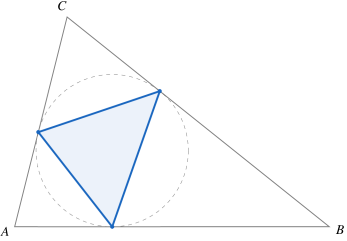
| contact triangle | incircle points of tangency |  |
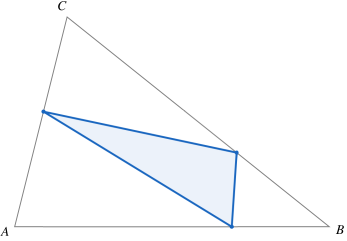
| extouch triangle | points of tangency with the excircles on the sides |  |
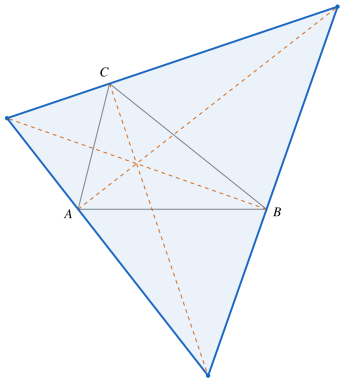
| excentral triangle | the three excenters |  |
| tangential triangle | intersections of tangents at the vertices to the circumcircle |  |
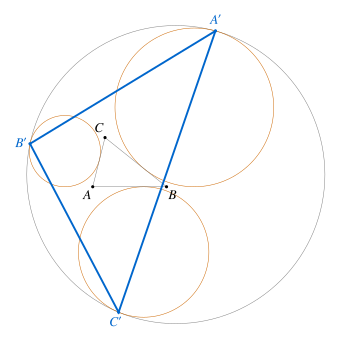
| Apollonius triangle | points of tangency of the excircles with their enclosing Apollonius circle |  |
For the Apollonius triangle row, write  ,
 , and
 , where
 |  |  |
(7)
|
 |  |  |
(8)
|
Both are homogeneous of degree 6 and symmetric in their last two arguments, so they are triangle
center functions of the same degree. Multiplying the three rows of the trilinear
vertex matrix of the Apollonius triangle
by  ,
 , and
 , respectively, gives the type 1 form above (Lozada 2025).
