

A central conic is a nonempty, nondegenerate real conic section having a finite center of symmetry: a half-turn about this point maps the curve onto itself. The central conics are the ellipse, including the circle as a special case, and the hyperbola (Coxeter 1969, p. 117). A nondegenerate parabola has no finite center.
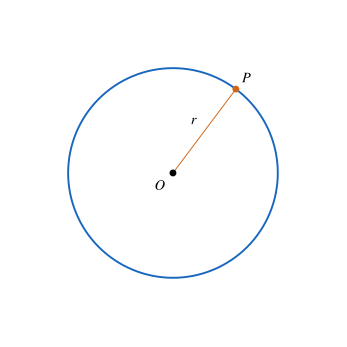
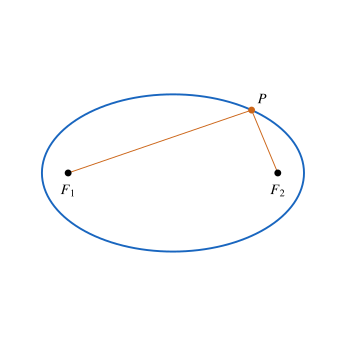
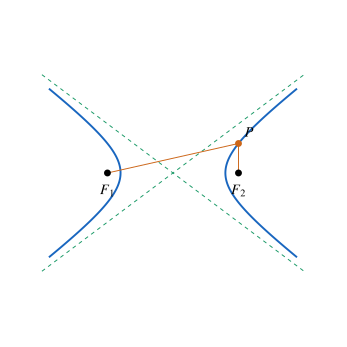
The following table compares standard forms centered at the origin. Here  ;
for the noncircular ellipse,
 ; and for the hyperbola,
 and
 . The last column gives the eccentricity
 . Each drawing is one representative of
its class. In the drawings, the curve is blue. Orange segments join the marked point
 to the center
 or the foci
 and
 , where present. The green lines
in the hyperbola drawing are its asymptotes.






In Cartesian coordinates, write the equation of such a conic section as
 |
(1)
|
Its center  , when finite, satisfies
 |  |  |
(2)
|
 |  |  |
(3)
|
These conditions remove the linear terms under the translation  ,
 , so the translated equation
is unchanged by
 .
When
 ,
the unique solution is
 and
 .
Thus the conic section is central iff
 . For
 it is an ellipse, while
for
 it is a hyperbola.
For an ellipse, its center is the midpoint of its two foci. For a hyperbola, it is both the midpoint of the foci and the intersection of the asymptotes.
