

Cauchy's perimeter formula states that the perimeter  of the boundary of a compact convex set
  with nonempty interior in the
plane is the integral of its
orthogonal projection lengths
over all unoriented directions. If
with nonempty interior in the
plane is the integral of its
orthogonal projection lengths
over all unoriented directions. If  is the length of the orthogonal projection of
  onto a line whose direction
makes angle
onto a line whose direction
makes angle  with a fixed axis, then
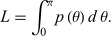 |
Equivalently,  is the distance between the two supporting lines perpendicular to that direction.
In particular, if this distance has the constant value
is the distance between the two supporting lines perpendicular to that direction.
In particular, if this distance has the constant value
 ,
the formula gives
,
the formula gives  , which is Barbier's theorem.
Cauchy's perimeter formula is the two-dimensional case of Cauchy's surface area formula.
