

The CANDECOMP/PARAFAC decomposition, also called the canonical polyadic or CP decomposition, expresses a tensor as a sum of
tensor direct product terms of tensor
decomposition rank one (Kolda and Bader 2009, p. 463). For an order- tensor
 , with positive integer
 ,
an exact decomposition is
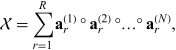 |
where  denotes the tensor direct product and each
factor is a vector. The least possible number
 of summands is the tensor
decomposition rank. An approximation with fewer terms is used to compress multiway data.
For a matrix, this gives a sum of matrices of matrix rank one. For higher-order tensors, it provides a different model from the Tucker decomposition, whose core tensor can have unequal sizes along its indices.
