

The Borcea variance conjecture is a family of bounds on the distance from each root of a polynomial to its
nearest critical point, expressed in terms of centered
moments of the roots (Khavinson et al. 2011). If
 has polynomial degree
  and roots
  ,
,  , ...,
  counted with multiplicity,
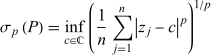
define
counted with multiplicity,
define
 |
(1)
|
for  .
For
.
For  ,
use the radius of the smallest closed disk
containing the roots. The conjecture asserts that every
root
,
use the radius of the smallest closed disk
containing the roots. The conjecture asserts that every
root  has a critical point
  with
with 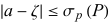 .
.
For  ,
the minimizing center is the geometric centroid
,
the minimizing center is the geometric centroid 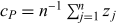 ,
giving
,
giving
![[sigma_2(P)]^2=1/nsum_(j=1)^n|z_j-c_P|^2.](/images/equations/BorceaVarianceConjecture/NumberedEquation2.svg) |
(2)
|
Thus  is the standard deviation of the roots.
Zhang (2026) proved that every root
is the standard deviation of the roots.
Zhang (2026) proved that every root  has a critical point
  satisfying
 |
(3)
|
The constant 1 is sharp. Monotonicity of  also establishes the conjecture for
  . The case
  is equivalent to the Sendov
conjecture, while
is equivalent to the Sendov
conjecture, while  remains open (Zhang 2026).
Zhang (2026) reports using ChatGPT for exploratory discussions, while independently developing and checking the proof. Codex generated an accompanying Lean formalization that the author reports was checked by the Lean kernel.
Bouthat and Fallat (2026) gave another proof of the  bound. Their analytic argument treats polynomial
degrees
bound. Their analytic argument treats polynomial
degrees  .
For degrees 4 through 2047, directed integer arithmetic
verifies finite certificates. This is an alternative proof of the quadratic case,
not a resolution of the open
.
For degrees 4 through 2047, directed integer arithmetic
verifies finite certificates. This is an alternative proof of the quadratic case,
not a resolution of the open  case.
case.
